How Umuzi is building a different pathway into South Africa’s digital economy.
Finish school. Study something. Get a job. It’s a tidy sequence, and hardly the journey most young South Africans actually follow.
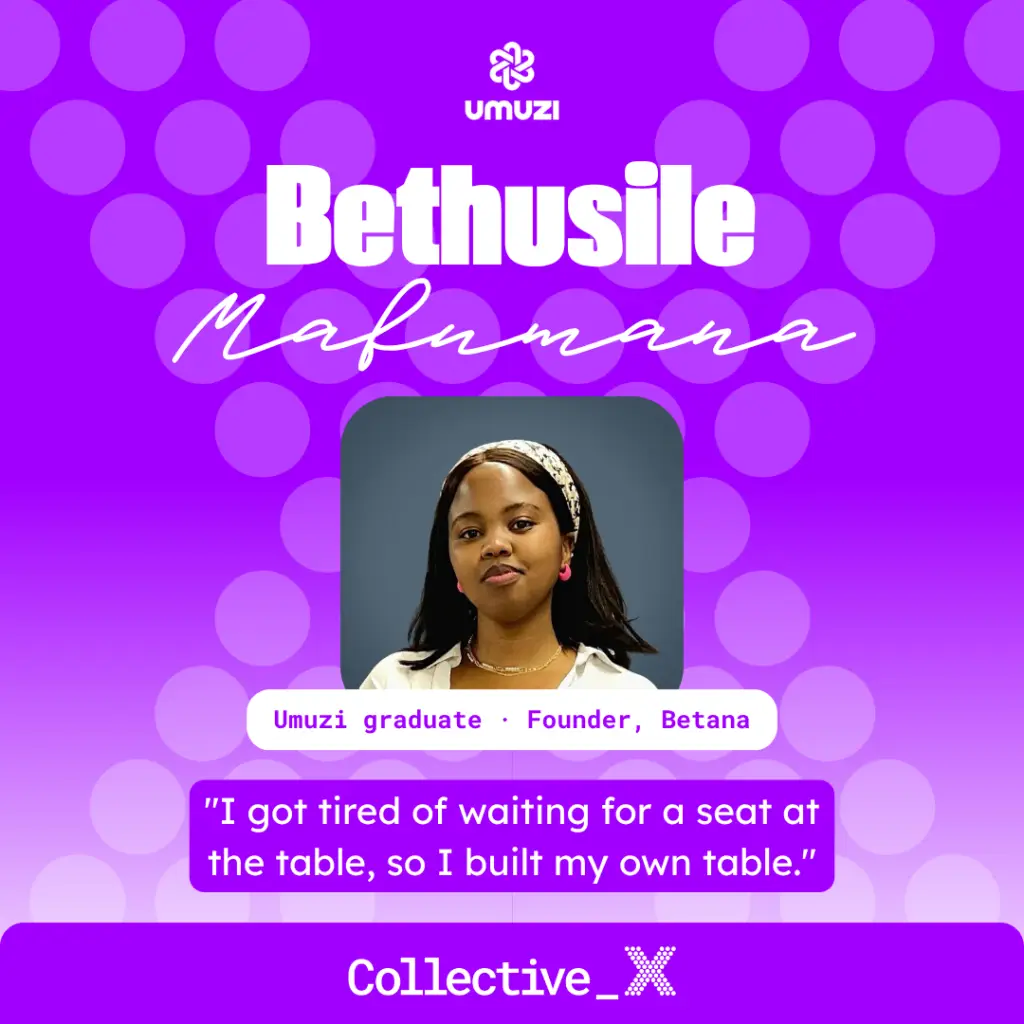
Bethusile Mafumana’s digital career journey has been a zigzag. A BCom in Accounting. Corporate and call-centre roles. Several ventures, some of which failed and knocked her confidence. A return to university for computer science. And now a software company she founded and runs from Gqeberha. Listed in order, it reads like a series of detours. Taken together, it is something else entirely: a young woman building a real income in South Africa’s digital economy.
That has consequences for how we think about digital skills training and youth employment. If success is only ever counted as a permanent job at the end of a course, we overlook an important way that young people actually start earning: freelancing, contract work, project gigs and businesses of their own. Entrepreneurship isn’t a consolation prize for those who couldn’t find employment. For many, it is the pathway that opens first, and it pays.
Bethusile’s journey shows what that route looks like in practice.
Building her own table
She grew up in Mthatha and now runs Betana Software Development & Digital Solutions, her own studio, from Gqeberha. Getting there involved a detour she had convinced herself was permanent: after one particularly difficult setback, she went back into corporate work and decided entrepreneurship wasn’t for her.
Technology opened a different path. She returned to university to study computer science and got involved with one of our implementation partners, Umuzi, whose Freelance Programme rebuilt her belief that she could operate as an independent professional. Today she is completing her honours degree while building Betana and working part-time at Umuzi.
What made the difference wasn’t only the technical training. Umuzi connected her to networks, mentorship and ways of thinking about business she hadn’t had access to before. Skills, people and confidence together are what turned starting a business from reckless into possible.
The barrier isn’t skills, it’s experience
Umuzi designed the programme around one of the biggest barriers facing young people entering the digital economy: getting meaningful work experience in the first place. Qualifications are rarely the bottleneck. Proof of work is.
So rather than preparing participants only for traditional employment, Umuzi, with the support of a co-payment from Collective X, deliberately built a pathway into freelancing and gig work, recognising that project-based work is an increasingly important source of both income and experience, and that it is often available to a young person long before a full-time role is.
Freelancing is still treated as the less conventional route, particularly by young job seekers holding out for a permanent contract. But a young person who has invoiced three clients has something a certificate cannot give them: evidence.
Inside the Umuzi x Collective X Freelance Programme
Participants arrived with existing technical foundations and spent six months building real-world experience through Umuzi’s work-integrated learning model, including practical projects, scaffolded impact gigs, and steadily growing portfolios.
The programme placed equal weight on the things that actually determine whether a freelancer survives: client engagement, communication, problem-solving, financial wellness, entrepreneurial resilience, personal branding, and how to find and win work on freelance platforms. Specialist partners added one-on-one coaching, freelance-readiness masterclasses and practical guidance on bidding and managing client relationships.
The results speak to the model. Of the 60 young people who joined, 54 completed the programme in May and formally transitioned into independent contractors. To date, nearly half of all completers have secured paid, project-based work, with some already moving from short-term gigs into longer-term contracts.
Beyond Bethusile, other learners on the programme said it gave them increased confidence, independence and resilience, and 84% said they would recommend the Freelancing Pathway to other Umuzi learners.
What this means for digital skills training
Digital infrastructure has made location far less of a constraint than it was. As Bethusile notes, reliable connectivity means a business in Gqeberha can pitch to a client in Johannesburg, Cape Town or abroad without relocating. The barrier is no longer only geography; it is access to experience, networks and the confidence to compete.
Programmes that treat those three things as core curriculum, rather than as extras, are the ones producing young people who can actually earn.
Bethusile sat down with Digital Council Africa to tell her story for the Women’s Month edition of their Conext magazine. Read the full conversation here.